FREE WEB TOOL · NO APP OR SIGN-UP NEEDED
HYROX pacing calculator
Choose your target. Get every run, station, and race-clock split.
Adjust the times you know—the rest adapts around you.
Your race settings
A plan built around you.
Or pick a target
THE ROAD TO YOUR FINISH
Your race plan
| Segment | Split | Race clock |
|---|
YOUR PLAN IS JUST THE BEGINNING
Find your pace.
Take it to race day.
Track the effort on Apple Watch with RoxDay. Add Pro for live pace targets, in-app goal planning, and a deeper look at every finish.
The web calculator is always free. Pro is an optional in-app subscription.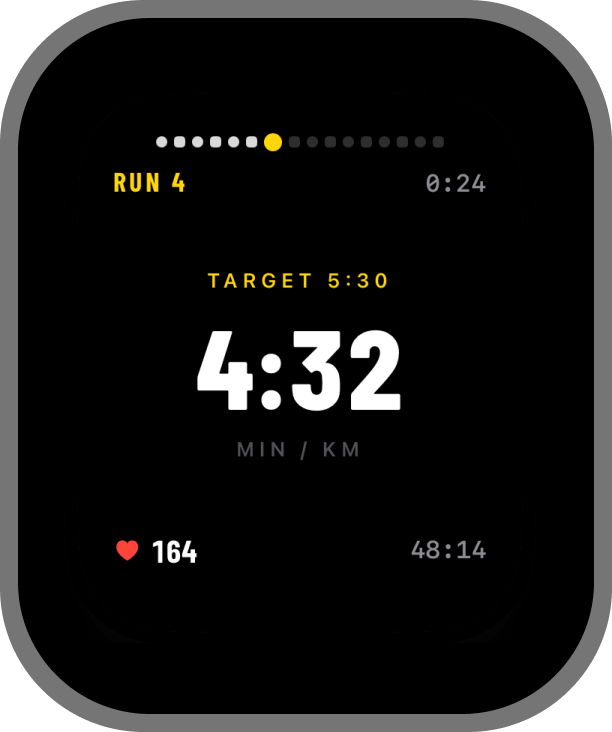
How this is calculated
1 · Real finishes, not formulas
We start from a public dataset of HYROX results across five seasons. Rows are kept only when all 24 legs are present and plausible and reconstruct the official finish time to the second — 90,254 of 93,978 finishes survive that check.
2 · Your cohort, your finish band
Athletes are grouped by division, category and (where the sample supports it) age group, then bucketed into five-minute finish bands. Inside each band we take the median of every individual leg, so the shape comes from people who actually finished near your target.
3 · Scaled to your exact goal
Your target sits between two bands, so we interpolate between them and scale the whole profile so every split adds up to your goal to the second. The relative shape is preserved — that's the part worth copying.
4 · Then you overrule it
Type your own time into any run or station and it's locked exactly as entered. Everything you haven't touched rebalances around it, in proportion to the median shape, so the plan still lands on your target. Set the roxzone total the same way.
Questions
Why aren't the runs all the same speed? +
Can I set my own station times? +
5:30 or just 530. That segment is then locked exactly where
you put it and everything you haven't touched rebalances around it to keep the plan on
your target. So if you know you'll hold 4:30 on wall balls but the sled push always
hurts, pin both and the calculator tells you what the runs have to look like for the
finish time you want. The × next to a locked split hands it
back to the model, and “Clear my edits” resets everything.Why don't the splits add up to the race clock? +
Should I follow these splits exactly? +
Does this cover doubles and pro? +
Is it free? +
Data source: “Hyrox Race Results” by Jeff Gugelmann, licensed CC BY 4.0, aggregated into cohort medians. RoxDay is not affiliated with, endorsed by, or sponsored by HYROX. HYROX is a trademark of its owner.